Thousands of industrial 3D models, built for robot training.
One of the most visible Czech robotics startups, building no-code automation for the manufacturing industry. Their perception model needed thousands of realistic industrial parts as 3D models. No such dataset was for sale, so we built one.
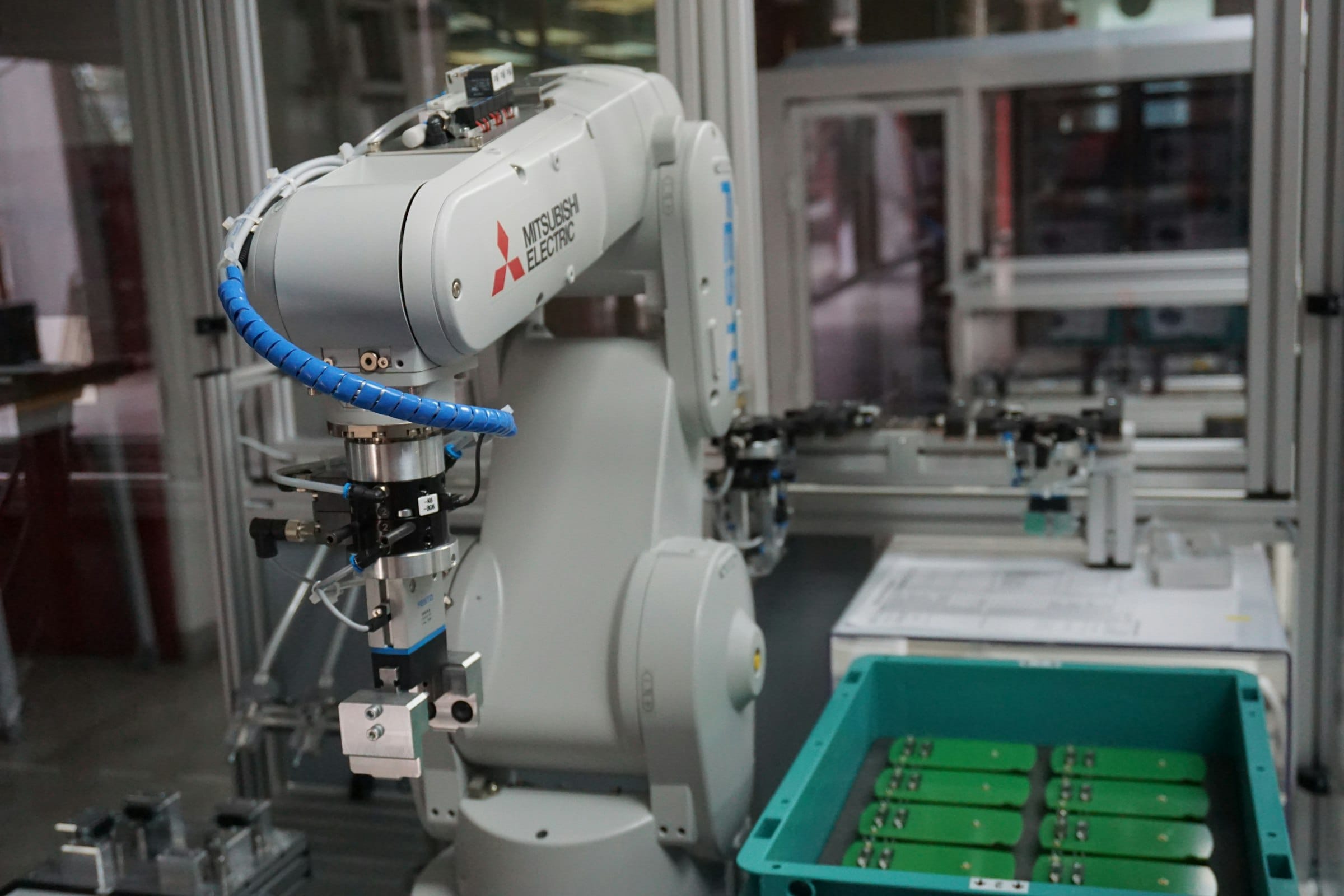 Case study – Robotics startup
- 1,200+unique industrial CAD models, sourced and cleaned
- ~6,000variants to train on
- 16variants from every base model
- 100%of sources checked for commercial use
The problem
The parts a robot meets on a factory floor, as data.
Brackets, sheet-metal enclosures, welded frames – parts found in every plant, but in no public dataset of a usable size, licence and quality.
The brief: real industrial geometry at real sizes, clean 3D meshes, enough variants to train on, and licences clean enough for a commercial product.
What we built
Sourced, cleaned, scaled, multiplied.
Models gathered in rounds, with the customer's engineers reviewing each, then a pipeline that turns one good model into sixteen.
- 01
Sourcing with review
Industrial models from public libraries and open datasets. The customer's engineers reviewed every round.
- 02
Licence check
Every source checked for commercial use. Only permissive licences and generated geometry made it in.
- 03
Cleaning and scaling
Every mesh checked closed and correct, and scaled to the sizes a robot actually handles.
- 04
Variants
Sixteen per model – scaled, stretched, rotated, mirrored – each one checked again.
How it works
One model in, sixteen out, all of them checked.
The pipeline is part of the result: it produces the next batch whenever one is needed.
- 01
Source
Candidates from libraries and generators, with the licence recorded for every file.
- 02
Check
Every mesh is checked before it counts.
- 03
Multiply
Sixteen variants per model, each checked like the original.
- 04
Deliver
In the structure the customer's own tools read.
The result
A training set that did not exist, and a pipeline for the next one.
The startup now has over 1,200 unique industrial models and around 6,000 variants to train on, with the source and licence of every file on record.
The pipeline stays and produces the next batch when it is needed. The same work with CAD models feeds into AI-Konstruktér, our product that designs frames from a brief.
The same approach works for
- Training data for vision and robotics where no dataset exists
- Cleaning, converting and checking large CAD libraries
- Generating part variants from a specification
Contact
A similar problem on your desk? Let's look at it together.
Thirty minutes with a founder: your process, your data, and whether a system like this one would pay for itself in your plant.
Or reach us directly
- Matyáš ProkopiusCo-founder
- Adam BulkaCo-founder