
How AI Helps Achieve ESG Goals - Driving Sustainability and Responsibility
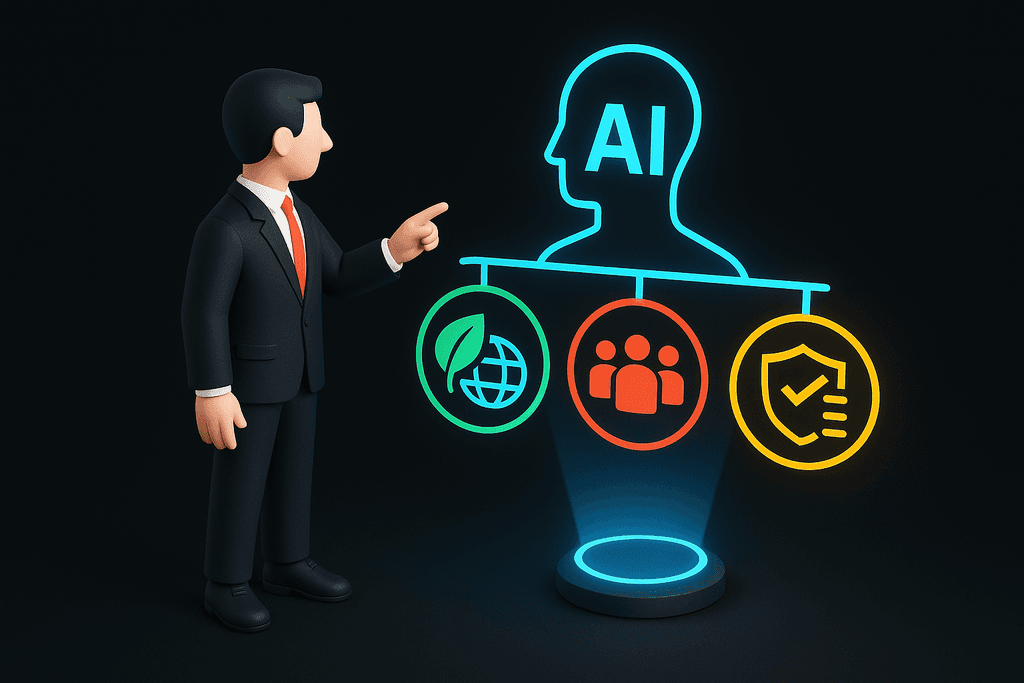
ESG – environmental, social, and governance – has become a boardroom priority alongside digital transformation. CEOs and CIOs face mounting pressure from investors, customers, and regulators to deliver on sustainability promises. Many enterprises have set ambitious carbon-neutral and social responsibility targets but struggle to achieve them. Enter artificial intelligence (AI). Long seen as a driver of efficiency and profit, AI is now equally celebrated as a catalyst for sustainability and corporate responsibility. By analyzing massive data and optimizing processes in ways humans cannot, AI is helping companies bridge the gap between ESG ambitions and tangible results. In this article, we explore how AI reduces carbon footprints, promotes fair and positive social impact, and strengthens governance – proving that smart tech can drive not just profits, but purpose.
Why AI and ESG Make a Powerful Pair
Meeting ESG goals is tied directly to long-term business value. The challenge is achieving them without harming efficiency. AI solves this by analyzing data at scale and finding win-win solutions. It helps companies reduce waste, cut emissions, and manage risks while saving costs. With digitization and AI, industries can decarbonize faster and make ESG both profitable and practical.
Environmental: Using AI to Cut Carbon and Waste
Climate action is central to ESG. AI helps by analyzing energy use, optimizing operations, and predicting maintenance needs. Smart energy systems adjust HVAC or lighting in real time, while predictive maintenance prevents wasteful breakdowns. Studies show AI-driven maintenance can cut emissions and incidents by up to 70%, saving costs and avoiding fines.
AI also supports renewable energy. For example, Lidl’s distribution center uses AI forecasts to balance solar supply and storage, running fully on renewables and reducing costs by 70%. Automakers like Renault deploy AI to pursue carbon-negative factories. Used wisely, AI not only lowers emissions but makes sustainability financially viable.
Social: AI for Fairness, Diversity and Well-Being
AI can strengthen fairness in HR by focusing on skills and masking bias. Properly designed recruiting platforms highlight qualifications, enabling more diverse hiring. Companies also use AI to analyze pay or promotion patterns and correct disparities.
Beyond hiring, AI improves work life. Smart scheduling creates fair shifts and reduces burnout. Wearables monitor stress and prompt breaks, while smart offices adjust light and temperature. In industry, AI vision systems boost safety, cutting incidents by up to 80%. The result: healthier workplaces, higher engagement, and stronger retention.
Governance: Smarter Compliance and Risk Management with AI
Regulators demand more ESG reporting, but manual processes are costly. AI automates data collection across systems, producing accurate reports in less time. Companies using AI achieve 95–99% reporting accuracy while freeing staff to focus on strategy.
AI also monitors risks in real time, scanning contracts, news, or transactions for red flags. It enhances transparency by powering live ESG dashboards for stakeholders. Governance must also cover AI itself, ensuring fairness, compliance, and ethical oversight. Done right, AI strengthens trust and resilience.
Conclusion: Turning ESG Ambitions into Action with AI
AI is no longer just about automation. It enables companies to cut emissions, create fair workplaces, and manage compliance effectively. Success depends on tailored solutions, not one-size-fits-all tools. Firms that integrate AI into ESG strategies reduce costs, boost efficiency, and gain investor trust.
SURG Solutions helps enterprises design secure, custom AI systems – from predictive analytics to on-premise LLMs – ensuring ESG goals become measurable results. Companies adopting modern AI will set the standard for sustainable, ethical growth.
Summary
AI is becoming a crucial enabler for enterprises striving to achieve ESG goals. It helps reduce carbon emissions through energy optimization and predictive maintenance, improves social impact with fairer HR processes and employee well-being tools, and strengthens governance via compliance automation and real-time risk monitoring. When deployed responsibly, AI allows companies to align sustainability with efficiency and profitability, turning ESG ambitions into measurable results.
Sources
Gartner (2023). Survey: 80% of AI Projects Will Remain Alchemy Through 2025.
Harvard Business Review (2021). How AI Can Help Organizations Meet Their ESG Goals.
PwC (2023). How AI Can Accelerate Your ESG Strategy.
AACSB (2022). How AI Supports Social Responsibility in the Workplace.
Schneider Electric (2023). AI and Digitization for Decarbonization.
ESG Today (2024). AI in ESG Reporting: Streamlining Data Collection and Compliance.